


Report on the 2025 Federal Financial Statements: narrow window of opportunity for reforms
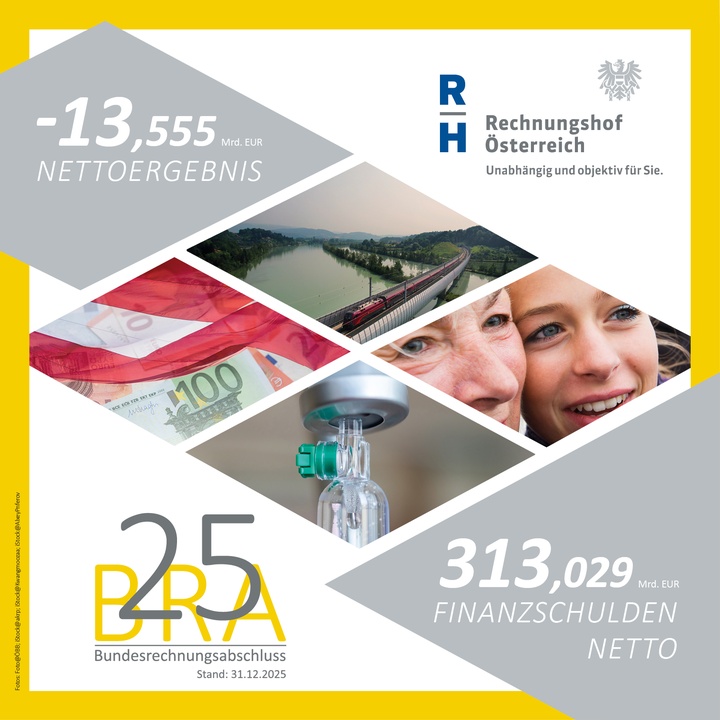
In 2025, the federal budget once again recorded a marked negative net result, which amounted to minus EUR 13.555 billion. Financial debt increased by 4.6 per cent to EUR 313.029 billion. Since mid-2025, Austria has been subject to the EU’s excessive deficit procedure. In 2025, the government deficit amounted to 4.2 per cent of the gross domestic product (GDP); government debt (Maastricht debt) reached 81.5 per cent of GDP. In its report on the 2025 Federal Financial Statements published today, the Austrian Court of Audit (ACA) cautions that, against the backdrop of rapidly growing expenditure in certain areas, structural reforms are the only way to significantly reduce the government deficit and bring down Maastricht debt in the long term. No concrete steps – for example for the necessary reform of the healthcare system – have been identified, not even in the Federal Government’s draft budget for 2027 and 2028. The window of opportunity for reform measures remains open until the next financial equalization negotiations in 2028. Until then, decisions on political direction must be taken in order to achieve longer-term objectives that will enhance Austria’s competitiveness.
Political will for reform is needed across all levels of government
In recent years, the ACA had already emphasized that structural reforms are necessary to ensure the long-term stability of public finances, in particular in the areas of healthcare, old-age care and pensions as well as education, energy, funding programmes and bureaucracy reduction. In May 2026, it published a paper in its Added Value series setting out reform proposals for the healthcare system, with a particular focus on care structures, financing and governance ( available at www.rechnungshof.gv.at/Gesundheit2040 pdf (in German)). The ACA believes it is a matter of urgency to develop a target model for the 2040 healthcare system and align financing flows accordingly. Achieving this requires a political will for reform across all levels of government, covering all the areas set out above.
The economy grew and inflation rose in 2025
The context for the Report on the 2025 Federal Financial Statements: after two years of recession, the Austrian economy returned to real economic growth amounting to 0.6 per cent in 2025. Inflation rose to 3.6 per cent in 2025, compared to 2.9 per cent in 2024. The unemployment rate reached 7.4 per cent.
The federal budget once again records a negative net result
Revenue increased by EUR 2.188 billion compared to the previous year and reached EUR 107.762 billion, which was primarily due to higher tax revenue resulting from higher wage growth, higher inflation and the slight economic recovery. Expenditure rose by EUR 1.987 billion and reached EUR 121.317 billion, which primarily resulted from higher contributions to social insurance providers, such as the pension insurance. Thus, the 2025 net result, which amounted to minus EUR 13.555 billion, remained negative, as in previous years.
Negative net assets, increase in financial debt
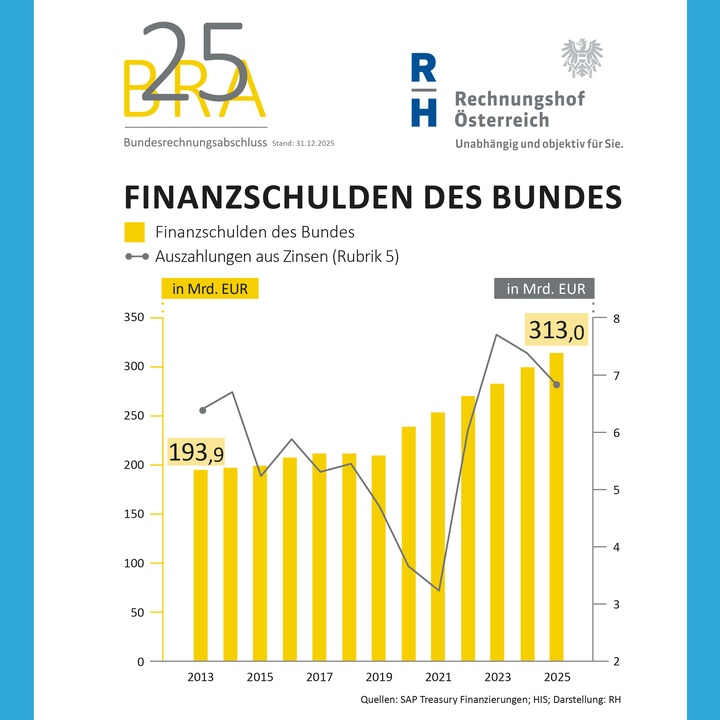
As at 31 December 2025, net assets were negative. They stood at minus EUR 244.882 billion. They declined by EUR 16.243 billion compared to the previous year. Federal assets stood at EUR 129.312 billion, i.e. they were EUR 2.075 billion lower than in the previous year, which primarily resulted from write-downs of equity interests. The assets were offset by borrowed funds amounting to EUR 374.194 billion. Financial debt accounted for EUR 313.029 billion of this. Despite the initiation of budget consolidation measures, it had risen by EUR 13.777 billion compared to the previous year. The increase in financial debt was mainly due to higher transfers, in particular for pensions, and growing interest payments. Since the end of 2019, financial debt as a percentage of economic output has risen from 52.8 per cent to 61.0 per cent of GDP. A total of EUR 66.602 billion in new debt was incurred in 2025. According to the Federal Government’s long-term budget forecast, interest expenditure is the expenditure category expected to grow the most by 2060.
Budget consolidation: the actual extent of the consolidation measures is difficult to determine
The EU’s excessive deficit procedure, which has been ongoing since mid-2025, requires Austria to take measures aimed at bringing the national budget back into balance. The Federal Government’s first policy package had been available as of June 2025. However, the ACA found that the reference values of the individual consolidation measures – which were based on different documents such as the 2024 federal budget, the document on 2024 budget execution, the 2025–2028 federal budgetary framework – were not fully transparent. This made it more difficult, and in many areas impossible, to grasp and assess the actual extent of the consolidation measures. On the bottom line, however, the Federal Government met the budgetary targets for both the operating and the cash flow statement.
If the deficit procedure is to be terminated as planned in 2028, the Federal Government must achieve a deficit of no more than 3.0 per cent of GDP in 2028 and subsequently keep it below this threshold. The Fiscal Advisory Council estimates that the consolidation and expansionary measures presented in the 2027 and 2028 biennial budget are not sufficient to meet this requirement. In 2025, the government deficit amounted to 4.2 per cent of GDP. Government debt rose due to additional borrowing. The government debt ratio stood at 81.5 per cent of GDP.
Significant deviation from budget estimates
The ACA’s comparison of the 2025 budget estimates with actual expenditure and revenue revealed significant deviations. For example, expenditure relating to grants to the ÖBB-Infrastruktur AG was EUR 4.113 billion lower than budgeted. The budget estimate was based on the grant contract for 2025 to 2030; however, in fact the grant contract for 2022 to 2027 was applied.
Criticism of advance payments at the end of the year
In the course of its audit of the 2025 Financial Statements, the ACA criticized that, particularly in the fourth quarter of 2025, many payments made by ministries and supreme bodies concerned future goods and services, without documentation as to whether advance payments were justified. These payments led to a higher budget deficit in the 2025 cash flow statement.
New division of competences complicates budget comparisons
Following the 2024 National Council elections and the swearing-in of the Federal Government on 3 March 2025, the competences of the federal ministries were reassigned through an amendment to the Federal Ministries Act (Bundesministeriengesetz, BMG), which led to a restructuring of the individual ministries’ budgets. These changes resulted in breaks in the time series and made comparisons with previous years in the affected areas more complicated and in some cases even impossible. For example, the 2022 amendment to the BMG transferred responsibility for the area of broadband and telecommunications from the then Federal Ministry of Agriculture to the Federal Ministry of Finance; the 2025 amendment transferred it to the Federal Ministry for Media. As the budget structure was changed several times within a short period of time, the ACA considers that the core principles of budget clarity, transparency and economy, as set out in the Federal Organic Budget Act (Bundeshaushaltsgesetz), are not fulfilled, particularly because financial management cannot be compared over time, or only with considerable effort.
Press release on the Report on the 2025 Federal Financial Statements – in German (pdf)
Please note that loading the documents may take a little time due to the large amount of data.
Volume 2 on the Subdivisions of the Federal Republic is available in interactive format:
Interactive display: Volume 2: Subdivisions (in German)
An overview of the Federal Government’s assets and borrowed funds is also available in interactive form:
Interactive display: assets and borrowed funds of the Federal Government (in German)
- pdf Datei:
- 818.0 KB
Overview of the Federal Budget 2025 (in German)
From the 2025 financial year onwards, the notes to the financial statements in Volume 1 will also be available electronically:
Notes to the financial statements (in German)
Volume 2: Subdivisions
Volume 2: Subdivisions (interactive (in German))
Print preview of Volume 2 (pdf) (in German)
- pdf Datei:
- 1,712.6 KB
Volume 3: Debts, Liabilities and Development of Public Finances (in German)
- pdf Datei:
- 4,057.4 KB
Volume 4: Regularity Audit Pursuant to Section 9 of the Court of Audit Act, Compliance Audits and Checks of Accounting Documents as well as Focus Audits 2025 (in German)
- pdf Datei:
- 4,073.0 KB
Set of Figures: Federation (in German)
- pdf Datei:
- 27,052.6 KB
Detailed Set of Figures: Federation (in German)
- pdf Datei:
- 5,244.1 KB
Set of Figures: Financial Statements of Organizational Units (in German)
Financial Statements in CSV Format (in German)
Statement of Financial Position – Long Version
Operating Statement – Long Version
Cash Flow Statement – Long Version
Statement of Comparison of Budgeted and Actual Amounts Operating Statement – Expenditure
Statement of Comparison of Budgeted and Actual Amounts Operating Statement – Revenue
Statement of Comparison of Budgeted and Actual Amounts Cash Flow Statement – Outflows
Statement of Comparison of Budgeted and Actual Amounts Cash Flow Statement – Inflows
Statement of Comparison of Budgeted and Actual Amounts Cash Flow from Financing Activities – Inflows
Set of Figures: Subdivisions (in German)
Budget Chapter 01 Office of the Federal President
Budget Chapter 02 Federal Legislation
Budget Chapter 03 Constitutional Court
Budget Chapter 04 Supreme Administrative Court
Budget Chapter 05 Austrian Ombudsman Board
Budget Chapter 06 Austrian Court of Audit
Budget Chapter 10 Federal Chancellery
Budget Chapter 11 Internal Affairs
Budget Chapter 12 Foreign Affairs
Budget Chapter 14 Military Affairs
Budget Chapter 15 Financial Administration
Budget Chapter 16 Public Expenditure
UG 17: Housing, Media, Telecommunications and Sport
Budget Chapter 20 Labour and Employment
Budget Chapter 21 Social Affairs and Consumer Protection
Budget Chapter 22 Pension Insurance
Budget Chapter 23 Pensions – Civil Servants
Budget Chapter 25 Families and Youth
Budget Chapter 31 Science and Research
Budget Chapter 32 Arts and Culture
Budget Chapter 33 Economy (Research)
Budget Chapter 34 Innovation and Technology (Research)
Budget Chapter 42 Agriculture, Forestry, Regions and Water Management
Budget Chapter 43 Climate Action, Environment and Energy
Budget Chapter 44 Financial Equalization
Budget Chapter 45 Federal Assets