

The Austrian Court of Audit published the "Koralmbahn Project"report
Once the Koralmbahn railway line is completed, the travel time between Graz and Klagenfurt am Wörthersee is expected to be reduced from around three hours to 45 minutes. In the "Koralmbahn project" report ("Projekt Koralmbahn (pdf)") published today, the ACA notes that ÖBB-Infrastruktur Aktiengesellschaft (AG) actively carried out project controlling for this infrastructure project, keeping the cost increases relatively low and responding to changing circumstances. Nevertheless, shortcomings and the potential for improvement were identified in the development of some construction lots. The topics covered by the audit included the assessment of the schedule and cost development and the performance in its function as a client who commissioned a construction. The audit period principally covers the years of 2012 to 2023.
Cost increase and time loss in tunnel construction
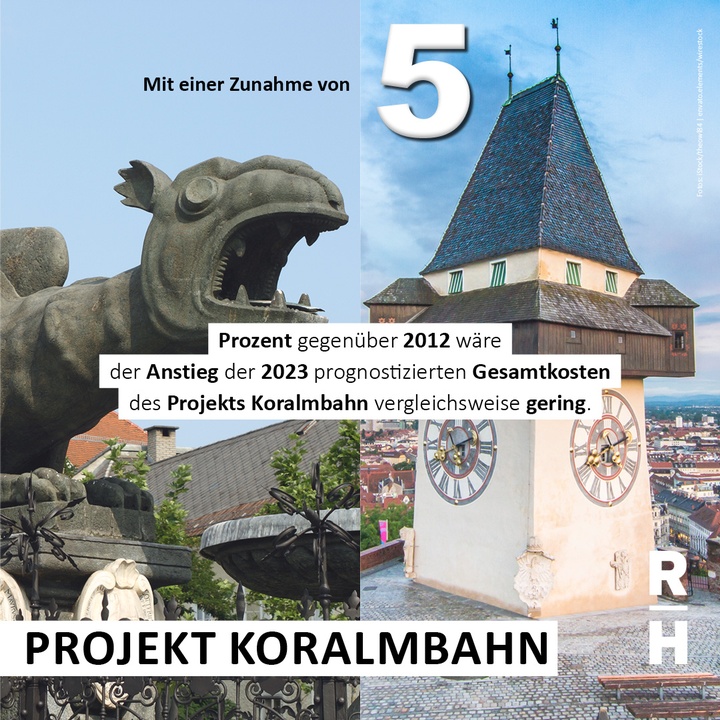
The ÖBB-Infrastruktur AG forecast the total cost of the Koralmbahn project at EUR 6.139 billion (as of the end of 2023). The cost increase compared to 2012 was kept low at five per cent (EUR 282.4 million), taking into account the subsequent integration of the airport line. Savings were achieved, among other things, through efficient contract awarding.
However, the inflation rate, the effects of the COVID-19 pandemic, as well as the technical and legal developments, contributed to the increase in costs. Furthermore, due to the difficulties with the excavation of the of the Koralm tunnel, the cost of the Koralm Tunnel KAT 2 construction lot, which was audited by the ACA, increased by EUR 297.75 million, and the completion time was delayed by around 31 months.
The geological conditions led to numerous problems, such as increased downtime, reduced tunnelling speed and increased machine wear. This resulted in high additional cost claims – more than a third of the original contract sum. A double shield machine was used for the tunnel excavation; the ACA considers this to be reasonable and plausible. However, the shield supplied by the contractor was longer than specified in the contract. The ACA found that there was no contractual safeguard and that the risks associated with the supplied tunnel boring machine were not transferred to the contractor.
Furthermore, the ACA’s audit revealed that ÖBB-Infrastruktur AG compensated for downtime during tunnel construction in a manner that deviated from the contract; contractual billing could have resulted in savings of between EUR 7.52 million and EUR 9.23 million.
Interests of the ÖBB-Infrastruktur AG
Overall, the ACA recommends a consistent implementation of anti-claim management (protection against unjustified renumeration claims by contractors) already during the tender review process in order to protect the interests of ÖBB-Infrastruktur AG. This includes ensuring the quality of tender documents, cost estimates and clarifications, as well as analysing the potential for claims during the tender review process.
Safeguarding competence in commissioning construction projects in the long term
ÖBB-Infrastruktur AG continuously adapted the Koralmbahn project organisation to the requirements of each project phase. However, in-house personnel only conducted the overall project management; for essential project management services, such as for construction management and site supervision, external consultants were engaged. This carries the risk of knowledge loss, particularly for the execution of large construction projects, and of a dependence on external experts. The ACA sees the frequent commissioning of external consultants to assess contentious issues as evidence of a lack of internal know-how.
The ACA therefore recommends examining the extent to which ÖBB-Infrastruktur AG can increasingly internally take on essential tasks in the management of construction projects. The goal is to strengthen own expertise and, in the long term, to secure the role of a client who competently commissions construction projects, as well as to reduce costs for external consultants and experts and the dependence on them.
Meeting deadlines: during the audit, the ACA identified significant risks
At the beginning of 2025, ÖBB announced that the "Koralmbahn railway and thus also the Koralm Tunnel" would begin operations in December 2025. In the course of their audit and in the report published today, the ACA auditors pointed out "significant risks" that, as of January 2024, still existed with regard to meeting the December 2025 deadline for full deployment: These included delivery bottlenecks and the timeframe for obtaining the operating licence in 2025, which the ACA considered to be tight, as well as possible conditions arising from the legal appeal against the contested decision on the "commencement of operations in 2023" ("Betriebsaufnahme 2023") on "Carinthia's end".
Overall, the ACA critically notes that ÖBB-Infrastruktur AG failed to meet the target of "completion in 2018" which was planned in the 2004 Koralmbahn contract. It also failed to meet the revised deadline of "full commissioning of the Koralmbahn railway in 2023" set out in the 2012–2017 framework plan. The two-year delay until 2025 is mainly caused by the additional time needed for tunnel boring.
The Koralmbahn line is part of the Baltic-Adriatic Corridor and thus part of the core network of the Trans-European Transport Network. Twelve tunnels and 23 new or modernised railway stations are being built on the double-track, electrified high-speed railway with a total length of around 125 kilometres. Construction of the first sections between Graz Central Station and the railway station in Werndorf began in 1998. The airport line is planned to be a part of the full expansion of the Koralmbahn. By bringing forward construction work, it would be technologically ensured that at Graz airport, a train station for long-distance travel could be built directly on the airport line at a later date. For the time being, the Ministry of Transport and ÖBB-Infrastruktur AG did not prioritise the long-distance railway station at Graz Airport and did not include the station in the framework plan.
- pdf Datei:
- 4,089.9 KB
- Umfang:
- 124 Seiten